
Headstones for “bingo” were chosen for legibility. Alas, many have been affected by weather & human activity over the years.
Sources: Revolutionary Soldiers Monument Dedication volume (RSMD); The Old Dutch Church of Sleepy Hollow Legends and Lore of the Oldest Church in New York

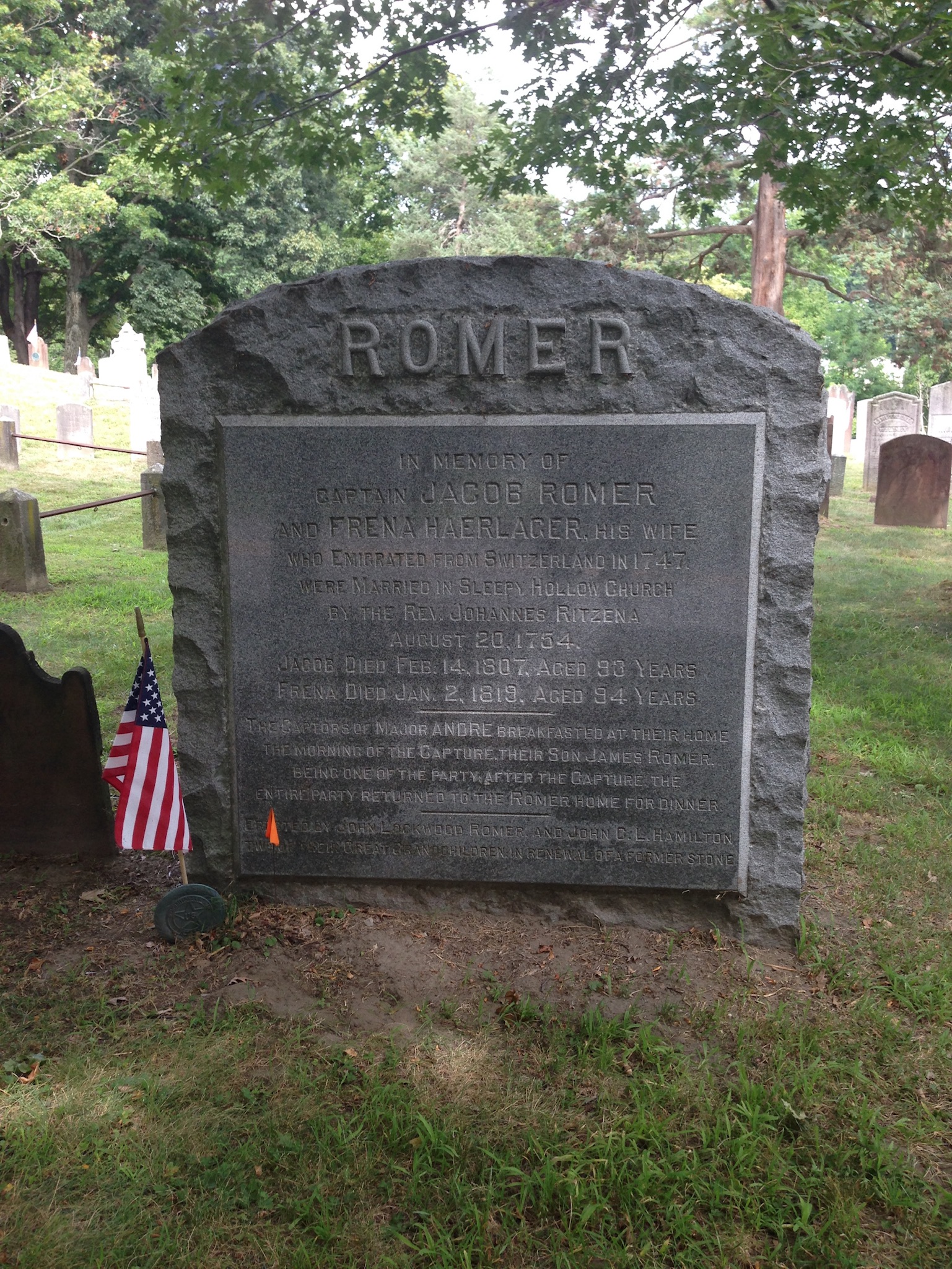
Captain Jacob Romer is buried with his wife Frena. Together, they are the Old Dutch Church love story. Star-crossed lovers who left their native Switzerland so they could be married and made their way to New York as indentured servants for two different masters. After working off his indenture Jacob started to search for Frena, and once found the two married in 1754 at the Old Dutch. Three of his sons also served in the militia – Hendrick, James and John. James Romer participated in the group that captured Major John Andre. Check out the story of the Romer Family pewter bowl associated with the capture of this British Spy Master!
Colonel John Odell first man to volunteer for the Westchester Militia in Tarrytown in 1776 at the age of 19. John Odell was a member of a patriot family, his father Jonathan was taken prisoner during a British raid of their farm. He served as a lieutenant at Mohawk Valley and later became a Westchester Guide – known for their knowledge of the road and country. Between January 1777 and Nov 1783, 25 Guides served as scouts, patrolling in the front of lines to warn of approaching hostile forces. As a Guide, Odell was a valuable asset to Generals Washington and Rochambeau.

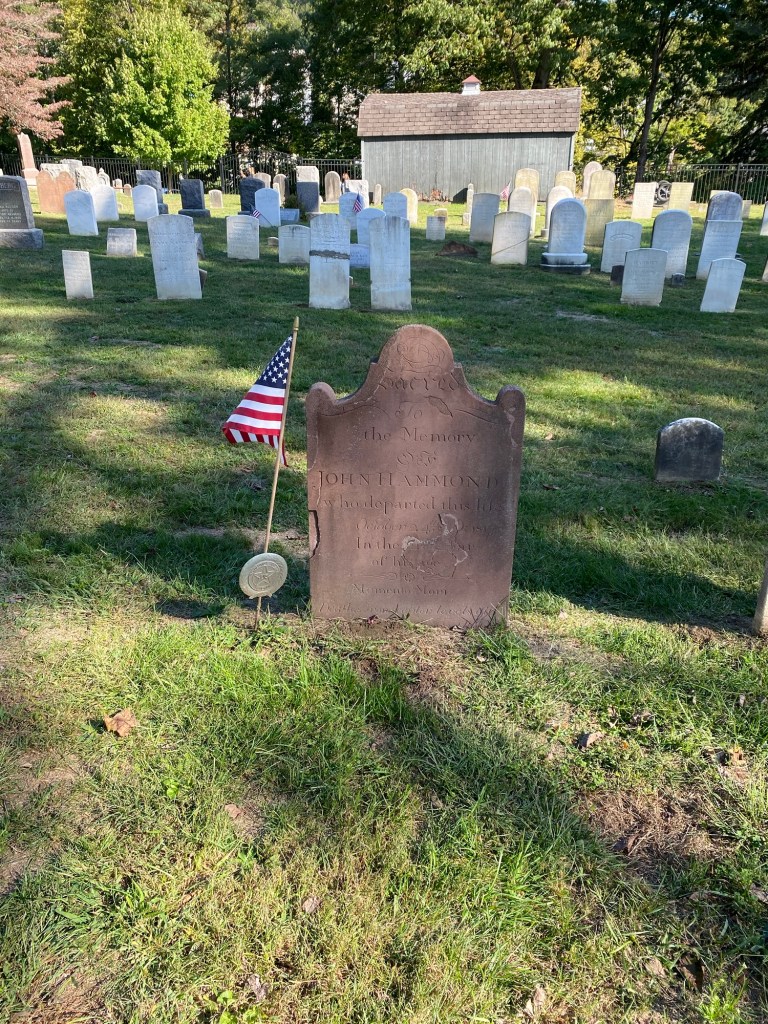
Pvt. John Hammond, Jr – Westchester Country Militia. Died 10/24/1817 – 72 yrs – Epitaph reads “Death’s iron scepter levels all, The old, the young, the great the small, The rich, the poor, must bow their head And mingle with the silent dead.” He served with his uncle, Col. James Hammond, 1st Westchester County Regiment.
Lieutenant Jacob Van Tassel – served under Col James Hammond, 1st Westchester County Militia. He was cousin to Petrus and Cornelius Van Tassel and known for his “Goose Gun” and exploits against the British. Taken prisoner at one point and later exchanged for a British officer in 1781. His epitaph includes these words: “The simple stone points To the honored grave, Where Sleeps the Patriot pure, the Soldier Brave, Reader if to thy heart thy country’s cause be dear; His service call to mind; his grave revere.” His headstone calls him Major – a rank he held in the militia after the Revolution.
After the war Jacob bought the land he held as a tenant farmer and rebuilt his home. In 1802, Captain Oliver Ferris purchased the property. His son, Benson, sold it to Washington Irving who renovated the home and called it Sunnyside.
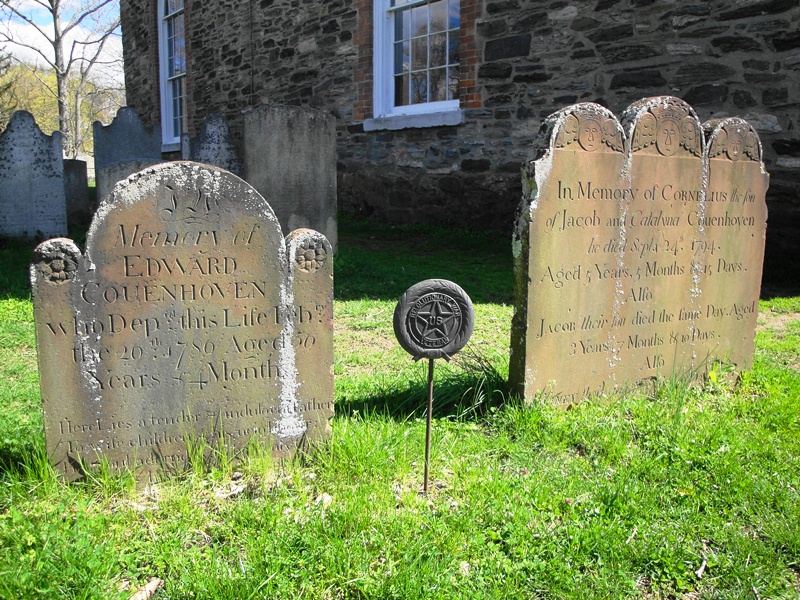
Edward Couenhoven – “Edward was the keeper of the Couenhoven tavern, famous throughout the Provinces for its excellent entertainment. As became such a public character, Edward was deep in the counsels of the Revolutionary leaders of the Manor and served as private under Capt. Daniel Martling. He was a prisoner of war for a considerable period. Washington was several times a guest at the Tavern and stopped there with Governor George Clinton and their staffs November 19, 1783, on the eve of the reoccupation of New York City.” from THE OLD DUTCH BURYING GROUND OF SLEEPY HOLLOW.
Capt Daniel Martlings – many of the patriots buried here served in Capt Daniel Martlings’ Company. The Martling family was one of the earliest families to settle in Philipsburg Manor.
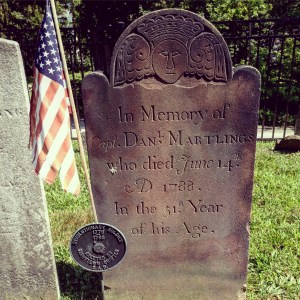
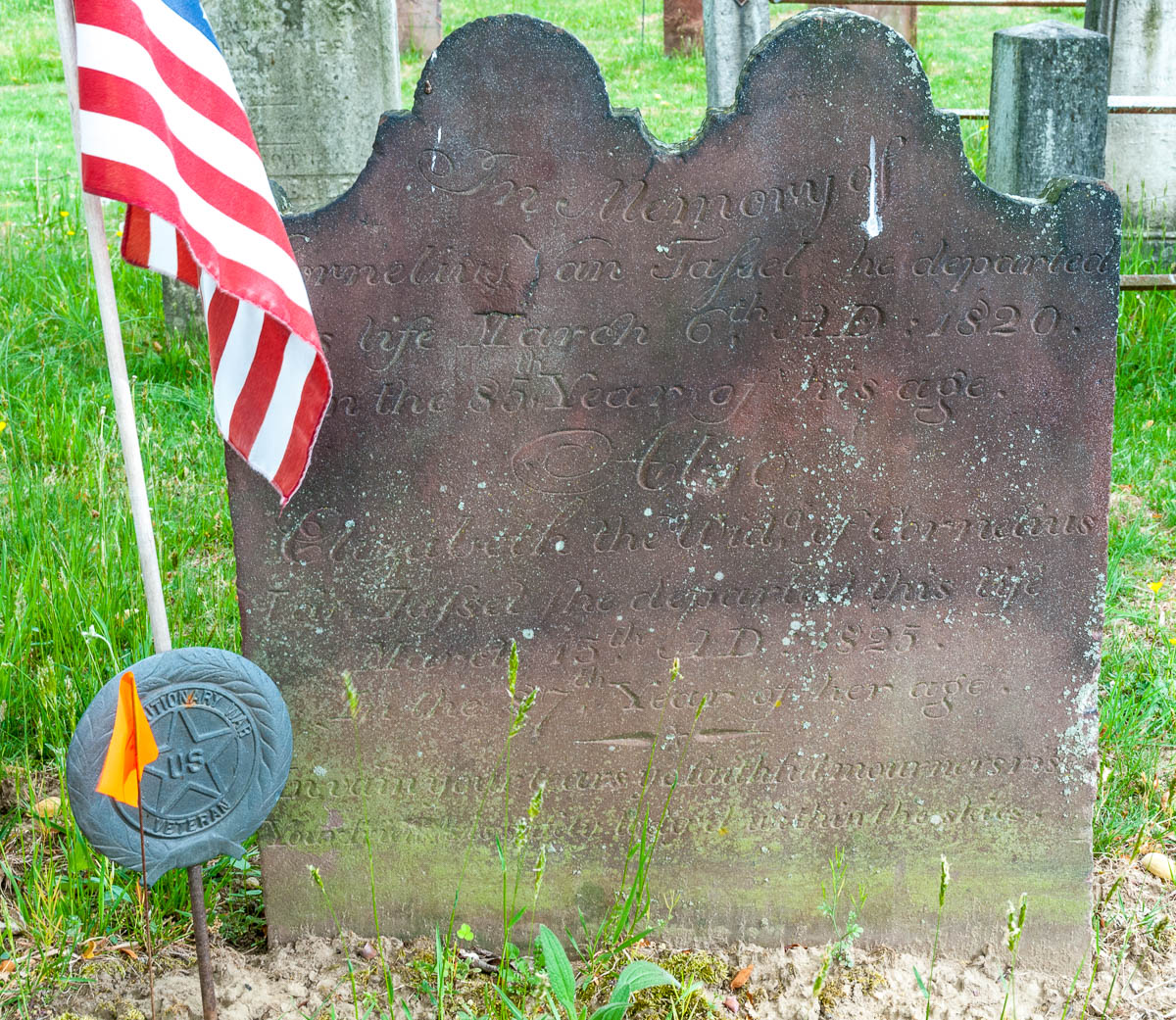
Lt Cornelius Van Tassel – buried here with his wife Elizabeth “In vain your tears ye faithful mourners rise, Your friends is safely lodg’d withing the skies.” Served in Captain Martlings’ Company. From the Revolutionary Soldiers Monument Dedication (RSMD) “Governor Tryon directed Col. Delancey· to recruit a company out of his regiment which were called Rangers. They were mounted, and the Governor, to stimulate enlistments in that branch of the service, gave then1 a reward of twenty-five dollars for the capture of every committeeman, and five dollars each for every deserter. …They were given the name of Cow Boys, …. On the night of Nov. 17., 1777, Peter and Cornelius Van Tassel were taken prisoners at their homes by Capt. Emmerick’s command from King’s Bridge, … The enemy having collected the Van Tassel’s stock of cattle, made sure their prisoners should not escape as they tied their hands to their horses’ tails, in which position they compelled them to drive their cattle to their camp. … While the dwelling was burning one of the soldiers actuated with praiseworthy feelings of humanity obtained a feather bed and threw it over the mother and child, who were then left to care for themselves as best they could. They afterward found temporary shelter in a dirt cellar, the only habitation left upon the farm.
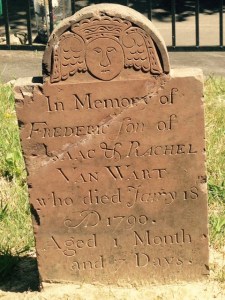
Frederic Van Wart was the infant son of one of the captors of Major John Andre – Isaac Van Wart. Isaac and his wife Rachel are buried in the Reformed Church burying ground in Elmsford. For many years Frederic’s headstone was missing until it was recently found in two pieces in an Ossining cemetery. The stones was repaired and returned to the Old Dutch Church Burying Ground.
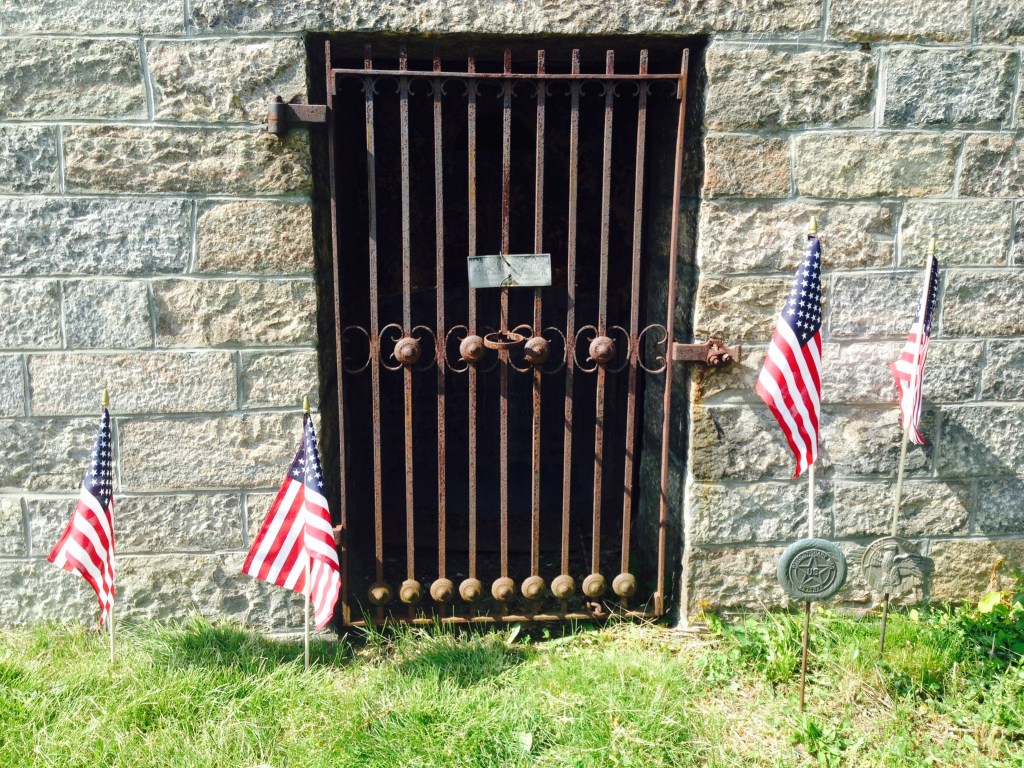
Sgt John Dean was among the first to join the patriot cause and participated in a early campaign to Canada in the 4th battalion, under Col. Van Cortlandt. John’s brother William perished from illness and all involved suffered from sickness that rendered them unfit for service. He was honorably discharged and returned to his family and regained his health. He re-enlisted. From the Revolutionary Soldiers Monument Dedication: “Sergt. Dean used to relate an account of the attack upon the statue at the Bowling Green, New York, when the people cut off the head, cast it into a wheelbarrow, and after wheeling it about the city, devoted it to be cast into musket balls, in which shape they intended to return it to the enemy, then on Long Island, &c. He further relates that he was also with the troops under Col. Putnam, and during the retreat, when so hotly pursued by the British, and nearly surrounded, he with another soldier hid themselves in the bushes, and afterwards, at night, swam across the Spuyten Deuyvil Creek into Westchester, and thus reached their homes in safety.”
In Sept 1780, in an attempt to curtail Tory cow boys from pillaging local farms, Dean sent seven militia men to patrol near Tarrytown. Three of these would capture the British Spy Master Major John Andre.
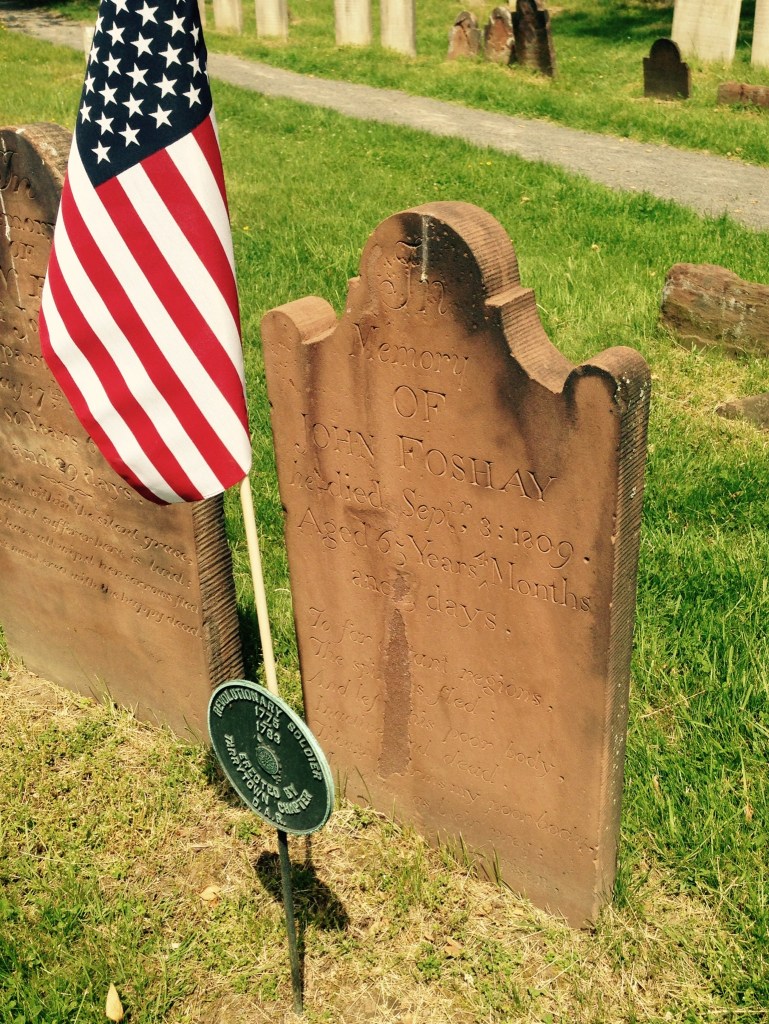
Pvt. John Foshay – epitaph “To far distant regions, The spirit is fled: And left this poor body, Inactive and dead. Though worms my poor body, May claim as their prey: Twill out shine when risen, The sun at noon day.” The Foshay’s were originally French Huguenots who immigrated to New Netherlands. Beautifully preserved stone.

Pvt Jacob Buckhout epitaph:
He’s run his race & won the prize, And gain’d a seat in Paradise, The aged & the youth do mourn, The husband, friend, & father’s gone, The church may now his loss deplore, The christian here is no more.”
Pvt John Yurks (Yerks), assisted with the capture of Major John Andre. In his words: “That when the said Van Wart, Paulding, and Williams, who had remained upon the highway, joined your petitioner [Yerks] and his company and brought Major Andre a prisoner with them, Paulding said, ‘We have taken a prisoner, and have searched him and found papers in his boots, and we do not know what to do with him.’ Whereupon your petitioner observed, ‘Let us take him a prisoner to Gen. Washington.’ Major Andre then said he would give us any sum of money if we would release him, but his offers were rejected by us, and we proceeded with him to the quarters of Col. Jameson, an officer of the American army.”

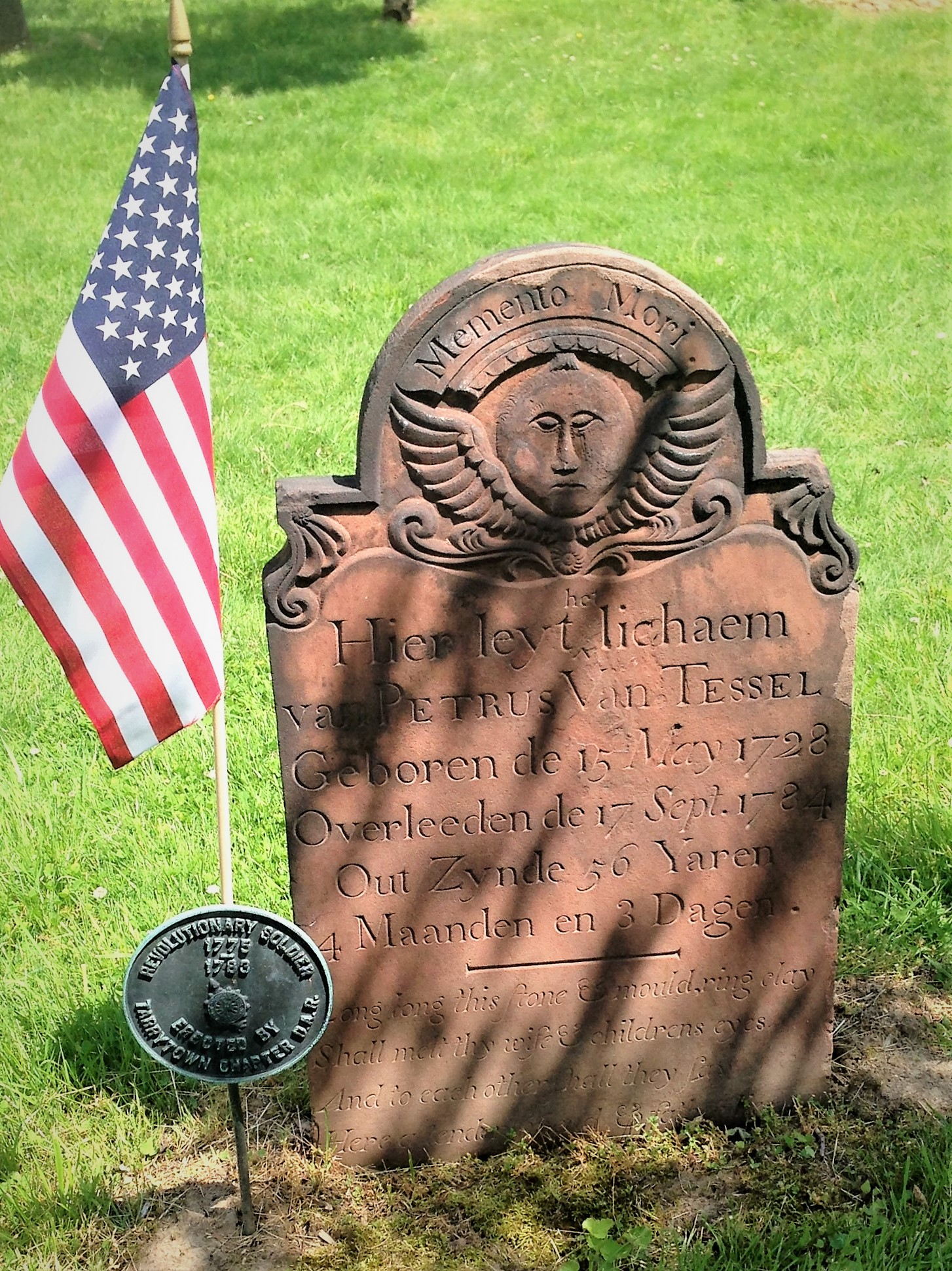
Pvt. Petrus Van Tassel – headstone is in three languages: English, Latin, and Dutch. “Long long this stone and mould,ring clay; shall melts thy wife & children’s eyes. And to each other shall they say, Here a tender friend & father lies.” Husband of Catriena Ecker and cousin of Cornelius Van Tassel. He was taken prisoner by the British and held for a year before being paroled for a British officer.
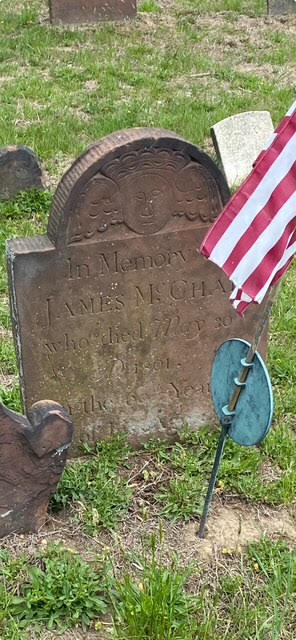
James McChain, father of Westchester Guide John McChain, who was killed by loyalists on Jan 23, 1783 and Hannah McChain, the first wife of Westchester Guide John Odell. Hannah hid John Odell in the rafters of her house when loyalists came looking for him and is credited for saving his life.

Pvt William Jewel served in Capt. Fowler’s Company and was the father of John Jewel in the Westchester County militia.
Captain Jonas Orser – epitaph:
Jonas Orser – New York – Capt. Hammond’s Regt. – Westchester Co. – N. Y. Mil. Rev. War – July 7, 1834
“Capt. Jonas Orser’s application [for pension] dated Aug., 1832, states that he was then a resident of Mt. Pleasant, and aged 88 years. In the years 1776-7 and up to the first part of 1778, when he rec’d his commission as Captain, he was a Lieut. in the Co. commanded by Capt. Abraham Ladieu; in the month of July, 1776, at Tarrytown; was called out at various times, in the years 1776, ’77 and ’78. Commissioned by Gov. Geo. Ciinton, June 26, 1778; commission on file with his application for pension. Jonas Orser was elected Overseer of the Poor of the Manor in April, 1779. Elizabeth, wife of Capt. Jonas Orser died in 1826, aged 77 years, as is recorded on her memorial stone in the old Dutch Churchyard. He died July 7, 1834.” RSMD


Lt Abraham Odell
“A tender Husband and Father dear, After a useful life spent here: In deaths cold arms he fell asleep, While kindred friends around him weep. Ye kindred friends why do you mourn, Or vainly wish for my return: Since ’tis decreed to be the lot, That all must die and be forgot.“
“Lieutenant Abraham Odell, another son of Jonathan, born 1760, served in the early part of the Revolution as one of the Westchester Guides. He also, for some time, acted as Adjutant and Secretary to Governor-General George Clinton.· Was a Lieutenant in 1781. After the war he was Member of Assembly for seven terms, and for nearly twenty years Supervisor of the town of Greenburgh. He married Anne Mandeville of Peekskill. Died I 820, and was buried in the old Dutch Churchyard, Tarrytown. Phebe Odell, a daughter of Abraham, married Rufus S. King of New York, and was so the mother of Rufus King, Esq., of Yonkers, the historian of the Odell family.” RSMD
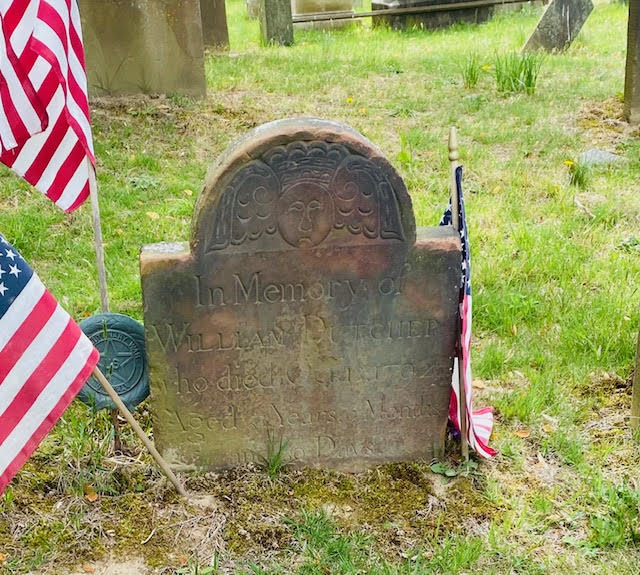
Captain William Dutcher
“The third son of Johannis Dutcher, was one of the leading and representative men of this Manor at the time of the Revolution. He was a man of ability, character, and substance. His patriotism was of the kind which needed no incitement to action, and his wife Catrina, was herself equal, as appears, to any emergency. He early offered his services in the cause of the Colonies, and was commissioned as Captain, 1775, with Daniel Martling and Geo. Monson as his First and Second Lieutenants.” RSMD

Pvt Solomon Brewer
“Solomon Brewer, whose name appears on the monument, is said to have been of the Boston Tea Party. Removed here after the Revolution. Was Census Enumerator in 1801. Lived on the White Plains Road beyond Glenville.” RSMD
Solomon Brewer was one of the three main stone carvers represented in the burying ground. Known for his soul effigies with the round faces and down-turned eyes. His burial stone was carved by his son James, who dispensed with the soul effigy and concentrated on stylized writing. John Zuricher is the third carver whose puffy faced soul effigies are found throughout the burying ground.
Epitaph: “Life is at best a narrow bound, That heaven allows to men; While pain and sorry fills the round, Of threescore years and 10″
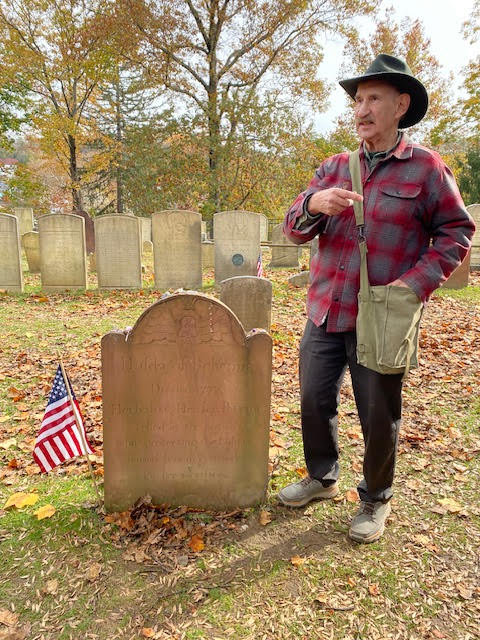
Hulda of Bohemia
Legend or history – you decide!
See my blog post about Hulda for more information about this legend that comes out of the revolution. The stone was recently carved in the style of John Zuricher and installed by master stone carver Robert Carpenter. The epitaph reads: Hulda of Bohemia Died c 1777, Herbalist, Healer, Patriot; Felled by the British while protecting the Militia, Buried here in gratitude for her sacrifice.
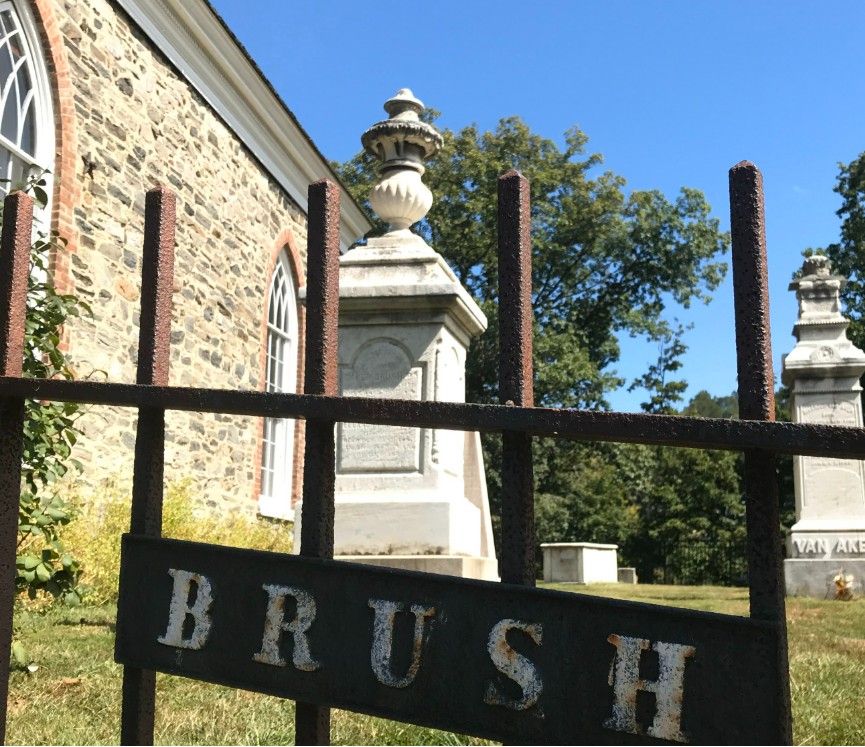
Eleanor Van Tassel Brush
Daughter of Jacob Van Tassel, Eleanor, known as Laney, is believed to be the model for Washington Irving’s Katrina Van Tassel. As a teenager during the Revolution, British troops tried to kidnap Laney when they were looking to capture her father Jacob. Irving tells the story in Wolfert’s Roost:
… during the absence of Jacob Van Tassel on one of his forays, and when no one was in garrison but his stout-hearted spouse, his redoubtable sister, Nochie Van Wurmer, and a strapping negro wench, called Dinah, that an armed vessel came to anchor off the Roost, and a boat full of men pulled to shore. The garrison flew to arms, that is to say, to mops, broom-sticks, shovels, tongs, and all kinds of domestic weapons; for, unluckily, the great piece of ordnance, the goose-gun, was absent with its owner. Above all, a vigorous defence was made with that most potent of female weapons, the tongue. Never did invaded hen-roost make a more vociferous outcry. It was all in vain. The house was sacked and plundered, fire was set to each corner, and in a few moments its blaze shed a baleful light far over the Tappan Sea. The invaders then pounced upon the blooming Laney Van Tassel, the beauty of the Roost, and endeavored to bear her off to the boat. But here was the real tug of war. The mother, the aunt, and the strapping negro wench, all flew to the rescue. The struggle continued down to the very water’s edge; when a voice from the armed vessel at anchor, ordered the spoilers to let go their hold; they relinquished their prize, jumped into their boats, and pulled off, and the heroine of the Roost escaped with a mere rumpling of the feathers.
Capt Oliver Ferris
“The records of the Pension Office at Washington show that Oliver Ferris enlisted May 10, 1775, and was in the expedition to Canada under Gen. Montgomery; was in Col. John Mead’s Regt. from Aug. 14, to Sept. 25, 1776 ; in Col. Wooster’s Regt. 1777 ; in 1778 Quartermaster in Col. John Mead’s Regt. ; March 9, 1779, appointed Commander of the war vessel ” Wakeman”; July 4, 1781, commissioned Brigade Quartermaster of the 4th Brigade of Militia of the State of Connecticut. Widow applied for pension Feb. 18, 1837. He died in August, 1825.” RSMD

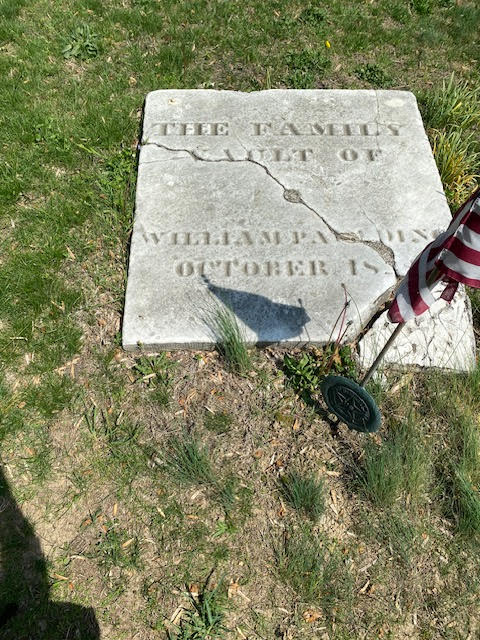
Commissary General William Paulding
“Commissary William Paulding was from the first one of the most influential men who supported the patriot cause on the Manor. He was a member of the Provincial Congress, and on Aug. 10, 1776, was appointed “Commissary of the Militia raised or to be raised in this State northward of King’s Bridge,” and so continued to render efficient service during the entire period of the Revolution, as the result of which, owing to the depreciation of the currency and the inability of the Government to make his promises to pay for supplies good, he was impoverished. Having been arrested for debts incurred in the public service he was confined for many months in the old log jail at White Plains. One day it burned down, and walking home to Tarrytown he was not afterward disturbed. A grand old patriot who deserved a better fate.” RSMD
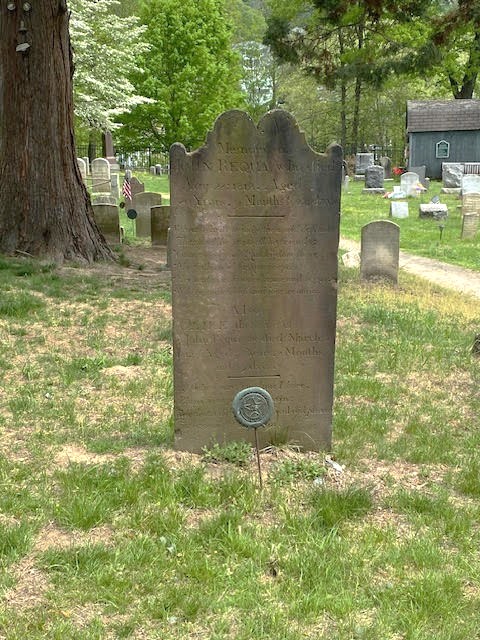
Pvt John Requa
According to the “Family of Requa”, he was the third son of Capt Glode Requa, Sr., buried here with his wife Olive (Aeltie Acker). He was enrolled in Capt Gabriel Requa’s company and took part in the capture of British prisoners in Sparta near Sing Sing. He was part of Col Samuel Drake’s company is was described as a blacksmith, blue eyes, dark hair and 5’9″. He left no descendants.
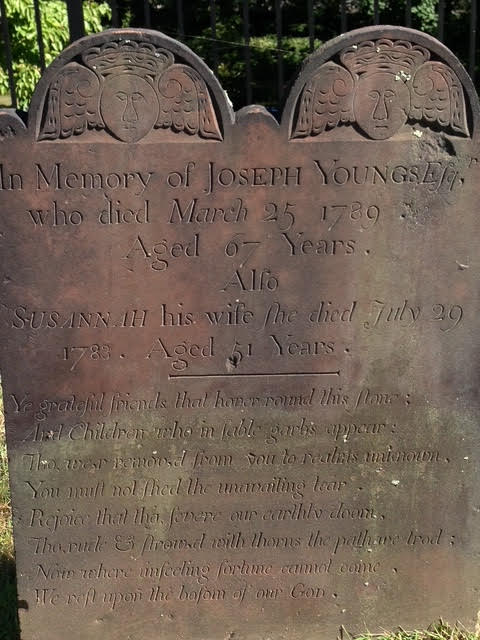
Pvt Joseph Youngs
“Joseph Youngs of the historic Youngs House noted as the headquarters on the American lines for so long a period, and until its destruction on Feb. 3, 1780, after which it was known as Youngs’ “Burnt House,” was a Justice of the Peace, and a Member of the Committee of Public Safety, as well as a member of Captain Gabriel Requa’s Company of Militia, and was a man of consequence before the Revolution, his family among the foremost on the Manor. He was captured in the raid made by Major Bearmore upon his house on the 25th of December, 1778, and remained a prisoner until the 25th of September 1779. The Youngs family had social prominence in the neighborhood. They had come from Great Neck, R. I., after 1760.” RSMD Buried with his wife Susannah. The double soul effigy headstone is by Solomon Brewer.

 Weekends at The Old Dutch